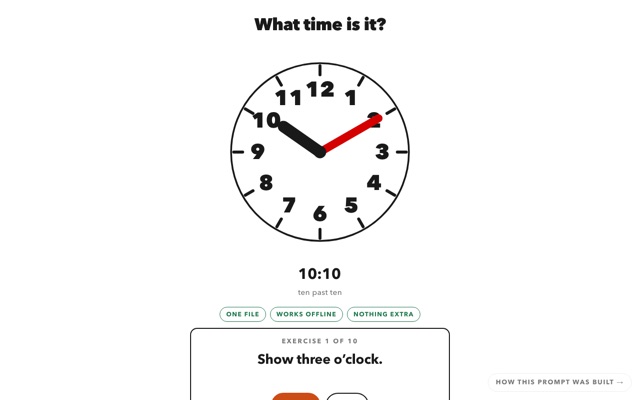
on screen at 0:14
The clock
A school lesson: one page that teaches a child to read the time.
Tieto · 90 minutes · the examples, with their prompts
Every example from the session, each one with the full prompt and the reason for each part of it.
vibe-coding.ovacode.cz · one address for every example
The slides and the notes I spoke from are not published — they are mine to give in the room. What is here is what I promised from the stage: every example, with its full prompt.
Five parts, in the order you would say them out loud. Skip “what we have” when you are starting from nothing; skip the don’ts until something annoys you.
When the first result is wrong, add one line. Do not rewrite the prompt from scratch.
Copy one, change the words that are about you, send it.
Use this when you want something for one person you can name — a child, a colleague, a class.
Something I can use in class with eight-year-olds learning to read the time. They practise on their own and know straight away if they got it right.

Here are the ten exercises I want to use: three o'clock, half past six, quarter past nine, …

One self-contained HTML file, everything inside, no external dependencies. It has to work on the school computer with no internet.

Zen style: light background, dark text, a lot of whitespace, numbers big enough to read across the room. One accent colour: Ferrari red. One thing on screen at a time.

Children drag the hands and the clock tells them if they are right. Do not add anything I did not ask for — no scores, no sounds, no menus. Ask me first.
Use this when someone else decides what it should do and you are only holding the keyboard.
My daughter wants a game where her cat jumps over boxes. She has to be able to win it. Losing should be funny.

The hero is her cat: orange, with a pink collar.

One self-contained HTML file, everything inside, no external dependencies. It has to run on the tablet with no internet.

The colours she picked: a blue sky that slowly turns to night, dark ink, the orange cat and the pink collar.

Count the boxes she jumps over and remember her best score. When she loses, the cat tumbles, the crate flies, stars go round its head. No coins, no shop, no ads.
Use this when you have a spreadsheet and no idea what is in it. Start here.
I want to understand who registered for my webinar: what job they do, what country they are from, how the room splits. I want to look at it.

This is the dataset of people who registered. Read it first.

A self-contained HTML page. Everything inside one file, no external dependencies.

Zen style: a lot of whitespace, light background, dark text. One accent colour, Ferrari red, and if the data needs more colours, make as many as it needs to show the data. Serve it step by step, a page per area, and finish with a one-page dashboard of everything.

Make it interactive so I can play with it and see the data from different sides.
Use this when you are about to send a requirement document. Send this instead.
To end an argument about what we actually mean. Instead of sending the requirement document, send something people can click through, so we find the misunderstanding on day one instead of in week six.

These four sentences from the requirement, and nothing else.

One self-contained HTML file. No server, no login, no install. I want to send it as an attachment and have it just open.

Zen style: light background, dark text, a lot of whitespace. One accent colour, Ferrari red, plus one colour per state so the four states are obvious. Hierarchy by font weight.

Three roles — employee, manager, HR — and I can switch between them. Four states: draft, sent, approved, rejected. Sample data only. Do not build authentication. Ask before you add anything I did not name.
Use this when two people on two devices need to see the same thing. A single file cannot do it.
A game two people can play against each other on two different devices — my laptop and my phone — with no sign-up. One person starts it, the other joins with a short code.

(nothing to work from — this one starts from an idea)

A small web app I can put on a server. One page, and the smallest possible server behind it. Keep the state in memory, no database.

Zen style: light background, dark text, a lot of whitespace. One accent colour, Ferrari red. Big enough to play on a phone with a thumb, and readable from the back of a room.

The room code has to be short and easy to read out loud over a call. If a phone drops, keep the board and let them come back with the same code. No accounts, no database, no scoreboard.
Three small apps. Each one carries a meaning.
A school lesson: one page that teaches a child to read the time.
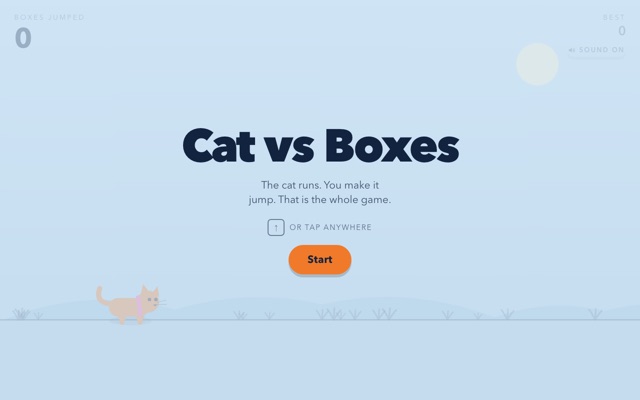
A game in minutes. More evenings on the same five parts, and it becomes a 3D world.
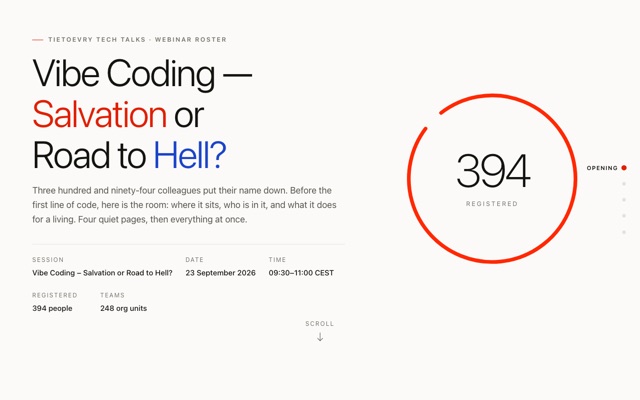
A dashboard built from a plain list of registrations.
Nobody watches a one-hour recording. Everyone reads one page.
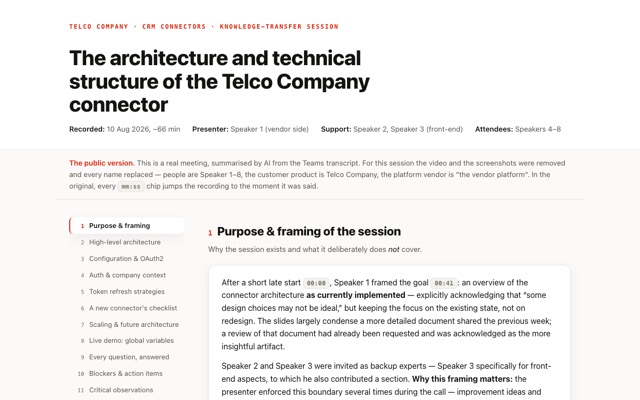
A real architecture call turned into one page. Every name removed.
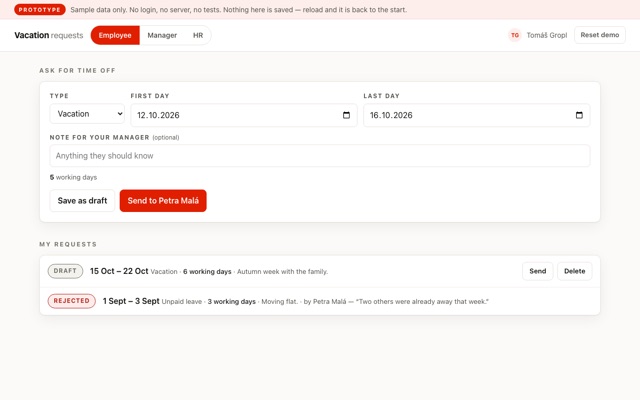
A requirement you can click: four sentences became three roles and four states.
Tic-tac-toe for two devices. The one example in the session that cannot be a single file — so it is the one that needed a server, and an address, and everything else that arrives with them.
Four pull requests, all tests green. Which one would you approve?
Four pull requests an agent wrote against a real C# service. Every problem in them is one met in code somebody was paid to write.
One sentence of a task, given to two copies of the same service. One copy has a harness. The difference is not the model — it is what the repo refused to let it do.
The four layers, weakest to strongest — and the six bombs held against each of them.